

We’ve all heard the news: Thin is in.
If you’re a woman with a TikTok account, the deluge of content about the so-called “skinny epidemic” has been unavoidable. The warning bells tolled in the early 2020s, when low-rise jeans crept back into style, and Kim Kardashian’s BBL shrunk back to the realm of anatomical possibility. But things really took off in 2023, when GLP-1s went mainstream. Seemingly overnight, a niche drug intended to treat Type 2 diabetes was the talk of the weight loss industry. Celebrity body transformations became subject to speculation — was it old-fashioned exercise and diet, or did they have semaglutide to thank?
As more celebrities (and, subsequently, regular people — our own family and friends) began to shrink, a cultural narrative took hold: The era of Body Positivity was dead, and Ozempic pulled the trigger. In this telling, the late 2010s were an anomaly — a brief period during which body standards relaxed, and a more diverse array of body types was represented in fashion and mainstream media. This era, most commonly defined as the “Body Positivity Movement,” represented meaningful change to many. The emphasis on self-acceptance and self-love was a stark departure from the punishing tabloid culture of the aughts, when any body that deviated even slightly from the norm was subject to ridicule. Things seemed to be getting better.
But perhaps they weren’t.
Recently, I listened to a podcast episode which complicated this narrative. Last December, Diabolical Lies — a cultural commentary podcast hosted by finance guru Katie Gatti Tassin and newly anointed literary it-girl Caro Claire Burke — released an episode titled “Is There a ‘Skinny Apocalypse’ in Hollywood?” In it, they break down the recent discourse surrounding the so-called skinny epidemic. One question they urge listeners to consider: Is skinny really “back” if it actually never left in the first place?
Fat Liberation activists have long criticized the Body Positivity Movement for its individualistic, corporate-friendly ethos. At its core, the movement hinged on two ideas: That women should practice self-love and self-acceptance, and that greater representation of “imperfect” bodies is needed in fashion and culture. These objectives strayed far from the aims of the Fat Acceptance Movement, which began in the late 1960s, and imparted explicitly political demands — namely, legal protections against anti-fat discrimination and greater accountability for the diet industry. The Body Positivity Movement did away with any demands that challenged systemic oppression, and instead asked women to look inward. What began as an effort to expand the rights of an oppressed group became a movement centred on individual women’s relationships with their own bodies. In place of tangible change in the lives of fat people, we got #Woke Victoria’s Secret Fashion Show.
Burke argues that our collective memory of this era is distorted — and I agree. The cultural consensus seems to be that the Body Positivity Movement had a meaningful impact on the representation of mid- and plus-sized people on screen and in fashion, but this simply isn’t the case. On runways, body inclusivity peaked in 2022, when just 2% of models wore a size 14+. In an (admittedly informal) survey of Met Gala attendees from 2010 to present, Burke counted fewer than two dozen plus-sized people. While brands and corporations cashed in, selling “self-love” in the form of overpriced shapewear, the models and stars populating our media diet were still, chiefly, thin.
Burke’s aim in providing this context is to debunk the narrative that, all of a sudden, thin is once again in. In the recent wave of discourse surrounding the skinny epidemic, she’s identified the distorting powers of what Rayne Fisher-Quann refers to as the “urgent-tense”:
“Open Twitter or read a handful of buzzy culture pieces on Substack (or any number of more official publications), and you’re likely to find about a million claims that things are ‘increasingly’ happening, behaviors are ‘becoming normalized,’ a vague topic or idea is ‘relevant now more than ever,’ that ‘we’ as a culture are different now than how we ‘used’ to be. Of course, certain things really are markedly increasing in recent years … but the hallmark of the urgent-tense is that its claims, even if technically defensible, are rarely precise or substantiated with data.”
In this instance, the use of the urgent-tense exaggerates the impact of the Body Positivity Movement by suggesting that body standards have shifted drastically and suddenly. The hosts of Diabolical Lies argue that this claim is ahistorical, and that the recent change in body standards — if there’s been any at all — is negligible:
“‘One of the foundational pillars of legitimacy for this panic is that something has changed. That we’re seeing a return to skinny, celebrities are disappearing — and that’s just not true. Skinny culture has always been incredibly, incredibly potent. If you want to nitpick over details, maybe there’s been a slight shift.”
And, unfortunately, I do want to nitpick over details.
I’m a fan of Diabolical Lies. I think podcasts are one of the most effective mediums for dissecting and debunking mainstream cultural narratives (see: You’re Wrong About). I love nothing more than a well-researched episode that challenges my own misconceptions. However, while I agree that the Body Positivity Movement was by no means the panacea for fatphobia, I think that’s actually beside the point. Fat liberation activists have been calling out the failures of the Body Positivity Movement since its inception — it was never for them, and they know that. I believe when people talk about the “rise of skinny,” they’re not actually talking about a decrease in plus (or even mid-) sized representation — they’re noticing that thin people are getting even thinner. And, unlike the hosts of Diabolical Lies, I think this “slight shift” matters.
When GLP-1s hit the mainstream, a handful of plus-sized celebrities debuted dramatic body transformations. At the time, these transformations received a lot of attention, with reactions ranging from congratulatory to vitriolic. Many of these formerly plus-sized celebs had built their brands around relatability, and some fans felt betrayed by their sudden alignment with the unrealistic body standards of Hollywood. But over time, the outrage quieted. The novelty of transformation wore off, and these celebrities melted into the sea of thin bodies that populate Hollywood. Small, but not too small — no cause for concern.
I’m not saying this is right — physical appearance is an incredibly unreliable measure of health. Eating disorders occur in people of all shapes and sizes, and cannot be diagnosed by sight alone. However, I feel it’s disingenuous to suggest no inferences can be made about one’s health based on physical appearance. Sure, you can’t diagnose an eating disorder just by looking at someone — but starvation does have physical symptoms. It’s something we can see. And when we start seeing it with greater frequency, I think it’s worth talking about.
The hosts of Diabolical Lies are right to point out that skinny never went out of style. However, that doesn’t mean we aren’t seeing a meaningful — and concerning — change in body standards. Women who were once thin are now gaunt, sporting sunken cheeks and pointy hip bones like they once sported cleavage. Burke and Gatti Tassin are also correct to critique the use of the urgent tense, and the ways in which it exaggerates the impact of the body positivity era. It’s true that none of this is new, that we’re simply witnessing an age-old pendulum swing — Gibson Girl to Flapper, Marilyn to Twiggy.
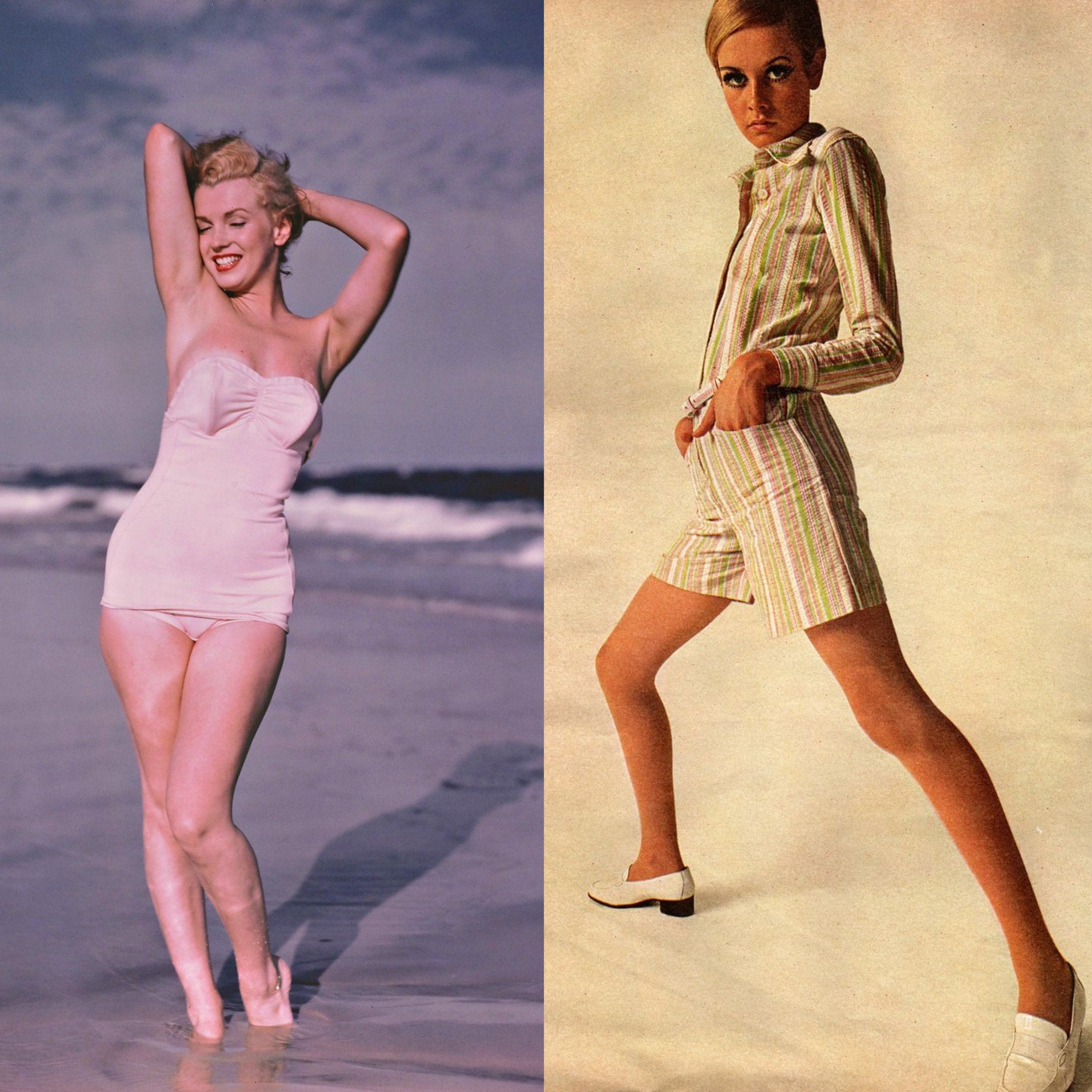
And yet, I still believe that this shift is worth talking about. Gatti Tassin discourages listeners from reading too much into “marginal changes to people who are already extremely thin.” But the thing is, when someone is already thin, a “marginal” decrease in weight matters. It’s the difference between a heart that beats to run and dance and live, and one that beats — just barely — to put one foot in front of the other.
It’s true that eating disorders are rarely triggered by envy of a thin celebrity, or even other thin people in one’s life. They’re far more complicated than that, a manifestation of depression, anxiety, the vague but ever-present patriarchal forces that invade women’s consciousness at puberty and never take leave. All this to say, a particular photo of Elsa Hosk’s abs in the 2014 Victoria’s Secret Fashion Show didn’t give me anorexia. But, once you’re infected by the sickness, it’s hard to exaggerate the importance these images — images of impossibly thin women — begin to take. They’re sacred, totems placed at the altar of thinness. Not exactly the cause, but perhaps the kindling.
I suppose what I’m saying is that two things can be true: Eating disorders aren’t necessarily caused by comparison, but they certainly thrive on it. When I think back on my eating disorder, I can’t extricate the images of the ultra-thin I was emulating from the illness itself. They were part of it, deeply ingrained. This isn’t their fault — they bear no responsibility for my, or anyone else’s, body image issues. In fact, I’m sure that most of them were at the mercy of the same sickness.
My point is that images are impactful. What we see and accept as desirable, as beautiful, matters. And when sternums and scapulas start creeping their way into that ideal image, I don’t think we do ourselves any favours by covering our eyes.